Why a verified track record changes who you should follow
Open X on any given day and search for your favourite asset. You will find hundreds of blunt opinions: "this is going to the moon", "watch out, a correction is coming", "load up now". They all sound certain. And there is the problem: how confidently someone says something has no relationship whatsoever with how often they are right.
The reason is simple and a little uncomfortable: on social media, the track record is optional. When someone is right, they screenshot it and show it off for months. When they fail, they delete the tweet —or simply never mention it again. No one keeps score. The result is a world where everyone is right, from memory, and choosing who to listen to becomes a matter of who your algorithm happens to like.
What changes when a prediction is sealed
A sealed prediction records, at the moment of publishing and in a way that cannot be edited afterwards, five things: the asset, the direction (up or down), the exact entry price at that instant, the target and the time frame. From there, time does its job. There is no interpretation: either the price reached the target within the time frame, or it did not.
That small change —fixing the data before knowing the outcome— transforms everything. It no longer matters how convincing someone sounds. What matters is what the market did afterwards. And because it cannot be deleted, misses count just as much as hits. A track record is only credible if it includes the mistakes.
From "I like them" to "they are right 68% of the time over the long run"
When every prediction leaves a trace, you can ask questions that are impossible on social media: is this person more accurate in crypto or in stocks? in the short term or the long term? are their targets ambitious or do they always play it safe? when they say they are very confident, are they usually right?
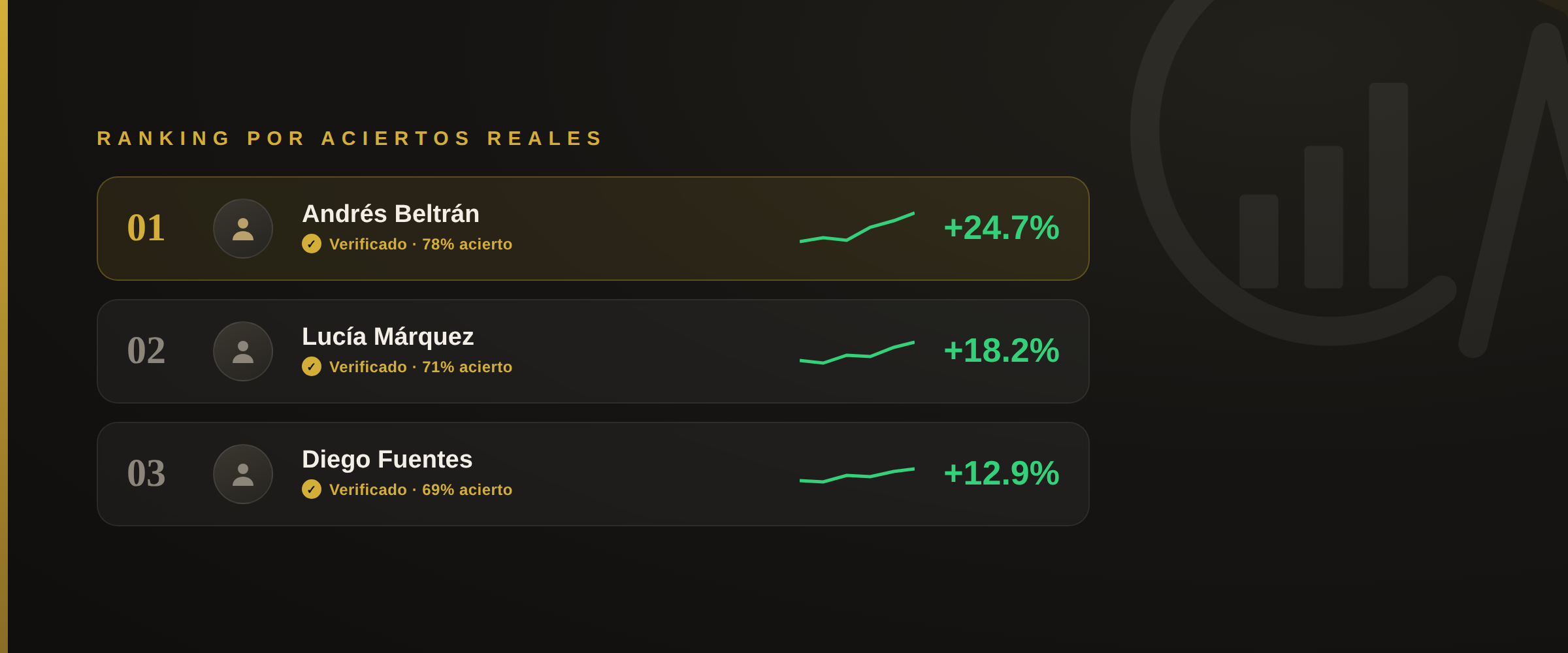
That is exactly what the GrandAlpha Score measures: a single number that sums up someone's verifiable track record from their already-resolved predictions. It does not count followers or noise. It counts real hits, the difficulty of what they predicted and how well-calibrated they are. Someone with 500,000 followers and no verifiable record does not score; an anonymous person with two years of hits does.
The goal is not to predict the future
It is worth saying clearly: none of this predicts tomorrow or guarantees results. The future is still uncertain and past performance does not guarantee future returns. What changes is not certainty —what changes is the quality of the information you decide with. Instead of trusting whoever shouts loudest, you trust whoever has a record you can check for yourself.
It is the difference between choosing blindly and choosing with data. And for anyone putting their money on the line, that difference is everything.
Read it for yourself
Verified predictions, a real ranking and live market data. Explore without an account.
Open GrandAlpha →
Discussion